Blog on Hospitality Services and Products

Hire or Buy Linen for Your Accommodation Business? Key Factors Explained

a pile of hotel linen
Are you managing or running an accommodation business, such as a hotel, short-term accommodation, or an Airbnb let? If yes, changing linen is one of the core aspects of your business as it can make or break your overall guest experience. Nothing appeals to most guests than clean and well-presented linen. Ensuring that every guest is greeted with a thoroughly clean and stain-free linen is an indication that the accommodation provider takes hygiene into consideration, and that will form a good basis for the guests to rate the overall cleanliness of the accommodation within seconds.
In the accommodation sector, it is expected that providers and operators change bed linens after every guest stay. For some guests on a longer stay, the policy on the time interval between changing linens may vary, but one can expect it every 3 to 7 days or upon a guest’s request. ONS reveals that the average guest stay is 11 days in England, 10 days in Scotland and 9 days in Northern Ireland.
Based on the average stay duration, one would anticipate a change of linen during a stay in most cases and a change after every guest departure. Assuming an average Airbnb occupancy rate of 70%, would mean around 2 guests per month on an average stay of 10 days per guests. This will mean at least replacing the towel and linen at least twice a month, and could rise to four times if linens are changed within each stay. This builds up the need for more linens and towels or a quicker turnaround time for the dry cleaning of these or the purchase of more at wholesale.
Based on the average guest stay in the UK, the total number of rooms, your policy regarding linen replacement during a stay and the overall occupancy levels will put things into perspective with regard to hiring, purchasing or dry cleaning linen yourself.


Key Drivers of Growth in the UK Bed & Bath Linen Market

bed and bath linen

Linen plays a very important role in hotels, short-term rentals, and related accommodation businesses. It is a strong and breathable fabric made from flax and is commonly used for bed sheets, towels, drapery, bathrobes, and other related applications. The demand for commercial linens is on the rise. Cognitive Research revealed that the global hotel linen market size will increase at a compound annual growth rate (CAGR) of 4.30% from 2024 to 2031. This indicates growing demand for both hiring and wholesale purchase of linen items. A report from Mordor Intelligence also revealed that the bath and linen market in the United Kingdom stands at $5.44 billion in 2026, and it is expected to reach $7.50 billion by 2030.

The Mordor Intelligence report further revealed that bed linen commands the largest share of the overall demand for linen products, accounting for about 63.27% of the linen market. This is because sheets and pillowcases are replaced more frequently than other textile product categories. Bath linen is also on an upward trend, as commercial sectors such as gyms, spas, corporate offices, healthcare facilities, yoga studios, restaurants, beauty salons, and event venues are now refreshing towels to meet stricter hygiene standards.

Linen purchases are split between consumers and businesses. Some companies prefer purchasing linens outright rather than hiring them on a recurring basis. This article focuses on the key drivers behind commercial purchase and/or rental of linen products. The residential customer segment makes up about 68.33% of the UK’s linen market, while the commercial sector accounts for the remaining 31.77% and is expected to grow at a 6.16% CAGR between 2025 and 2030. It is not surprising that commercial demand for linen is expected to grow over the next five years, which brings us to the key drivers for this growth.

Rising UK Guest Nights Drive Demand for Linen Hire

Linen on a bed in possibly a short-term apartment

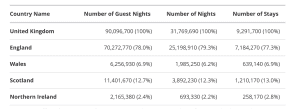
The Office for National Statistics (ONS) revealed some interesting data on the total number of guest nights on short-term accommodation offered  on platforms such as Airbnb, Booking.com and Expedia. It excludes stays in hotels and campsites.

Overview of some of the interesting short-term stay data points 

Total UK short-term  guest nights in 2024:  During the calendar year of 2024, approximately, 90.1 million guest nights were spent in short-term rental across the UK. Based on the below table, it clearly reveals that England received the giant share of these short-term stays with over 70.3 million. And this is based on the night stay per individual and not per occupied room. For example, if you have two guests staying in the same room for 3 nights that will be equal to 6 nights of stay. And if the room is occupied by a single guest for the same duration of stay, that will be considered as 3 nights of stay.  Over 78% of total short term night stays are spent in England. 

ONS short-term stays in 2024

How Changing Working Patterns Impact the Frequency of Office Cleaning in 2025

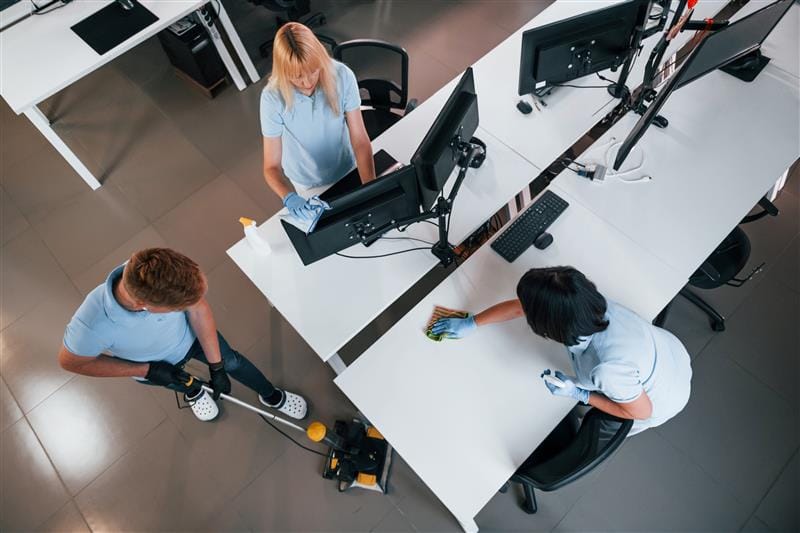
Workers cleaning am office

The workplace still has a place in today’s business environment. Despite the growing popularity of remote and hybrid working styles, most companies are still maintaining their office spaces and encouraging employees.The Office of National Statistics (ONS) reports that more than a quarter of workers in Great Britain (28%) were considered hybrid workers between the period of 8th of January to 30th March 2025. 

An additional report produced by Statista on UK remote and Hybrid working revealed that in August 2025, roughly 14% of workers in Great Britain, predominantly worked from home and approximately 22% are hybrid workers with occasional commute to the office. Onsite or fully-office based work comprise about 41% of the total workforce in the UK. The report reveals that the height of exclusively onsite workers or employees that were only travelling to work peaked in March 2022 at about 60% of the respondents sampled. While the highest percentage of remote workers was recorded in June 2020. There is a growing popularity of Hybrid working as the highest percentage of workers considered to be in this category was over 31% in November 2023.

The data from both ONS and Statista clearly indicates that more than a quarter of the UK workforce (28% and 22% respectively) are hybrid workers and around more than a third (41%) travel to work. This influences how often the workplace such as offices, warehouses, building sites and other spaces needs to be cleaned. Let’s explore the different scenarios that determine the frequency of clean required based on the different working modes. 

Things to Expect from End of Tenancy Cleaning

blog image of end of tenancy cleaning

When your tenancy agreement ends, one of the most critical aspects of moving out is making sure that the property is returned to its original state. End-of-tenancy cleaning is more than just a standard cleaning—it’s a deep cleaning process designed to meet the high standards expected by landlords and letting agents. In this post, we will cover everything you need to know about end-of-tenancy cleaning, including its meaning, costs, what it involves, and why hiring professionals might be the best option for you.


What Does End of Tenancy Cleaning Include?

End of tenancy cleaning is a comprehensive process to ensure the property is spotless. A professional end of tenancy clean typically includes:

Living Rooms and Bedrooms:

  • Dusting and polishing all furniture
  • Cleaning windows (inside), skirting boards, and doors
  • Vacuuming or steam-cleaning carpets